




AN EVENING DEDICATED TO LANGUAGES
At the DST, many children grow up with two, three or more languages: at home, at kindergarten, at school and with friends. How to make this work well, and what families can do to help, was the topic of our parents’ evening on multilingualism last week.
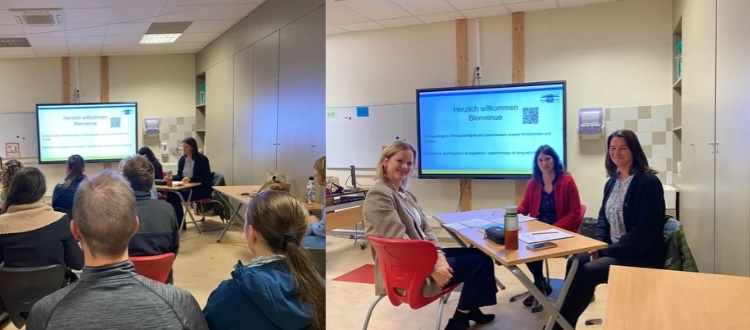
The evening was led by Marie-Fleur Despaux and Nadja Ehrich (primary school) and Anne Pellan (secondary school). Parents and families from all three sections attended: kindergarten, primary school and secondary school. The speakers combined scientific background with practical tips and gave insights into how our children learn languages.
For anyone who couldn’t make it, here’s a brief overview:
Five myths: a fact check
Myth 1: ‘Too many languages at once will overwhelm my child.’
Don’t worry! Children can learn several languages from an early age. Whether a child starts talking earlier or later varies from child to child, in both monolingual and multilingual children. What matters is how much of each language they hear and how vividly they experience it.
Myth 2: ‘If my child mixes languages, they’ll get everything muddled up.’
Quite the opposite. ‘On va au Spielplatz après l’école?’ isn’t chaos, it’s skill. Children switch between their languages according to clear rules.
Myth 3: ‘It’s best if I speak the school language at home, even if it isn’t my own.’
Better not. Your child benefits most from the language you feel at home in yourself. That’s where you have the widest vocabulary, the best stories and the right words for feelings. What’s more, a strong first language is the best foundation for every language that follows. Giving up the family language, on the other hand, risks your child losing it.
Myth 4: ‘If Mum and Dad speak different languages, it will confuse our child.’
Not at all. Two parental languages are no problem. Each parent speaks in whatever way feels natural to them, and the child grows up with both languages as a matter of course.
Myth 5: ‘Multilingualism is a disadvantage at school.’
If anything, it’s a head start! Children who already speak two languages often find it easier to learn another, English at primary school, for example. What they know in one language helps them learn the other.
Language support at the DST
Not all children at our school bring two or more languages with them: some speak only French at home, others only German, Spanish, English or another language.
These children also settle in quickly, because they experience the new language every day at kindergarten and at school: while playing, in lessons and with friends. Those who join later need a little more time at first, and we support them with targeted language support such as German as a Second Language (DaZ) lessons or small-group work, from kindergarten right through to the AbiBac.
If you’d like to read more now, a good place to start is the Mercator Institute’s fact check ‘Mehrsprachigkeit in Kita und Schule’ (Multilingualism in Nursery and School) and BIVEM’s multilingual leaflets for parents.
Would you be interested in another evening on this topic? Please do get in touch.
Our warmest thanks go to Marie-Fleur Despaux, Nadja Ehrich and Anne Pellan for an informative and thought-provoking evening, and to all the families who contributed their questions and experiences.